WHERE CAN I BUY JAPANESE KIMONO ?
Discover where to buy 100% authentic Japanese kimonos, including silk options. Learn about pricing, why kimonos can be new WHERE CAN I BUY JAPANESE KIMONO ?
HAPPENING NOW
KEY TAKEAWAYS
Where can I purchase authentic Japanese Kimono's?
How much is an authentic Japanese Kimono?
What is the price of an authentic Japanese Kimono?
Why are Japanese Kimono's expensive?
Which company sells silk Kimono's in Japan?
Contact SavvyJapan-Today.com at: +81.70.9041.6946 for information on how you can purchase authentic Japanese Kimono's made of Silk.
WHERE CAN I PURCHASE 100% AUTHENTIC SILK KIMONO'S IN JAPAN?
ADVERTISEMENT
Alright, friend — grab a cup of coffee, settle in, and let me just talk to you about this kimono. Because honestly, when I first saw the photos (front and back), I kinda just… stared.
You know that moment when something is so beautiful and so ridiculously detailed that you forget what you were doing? Yeah. That.
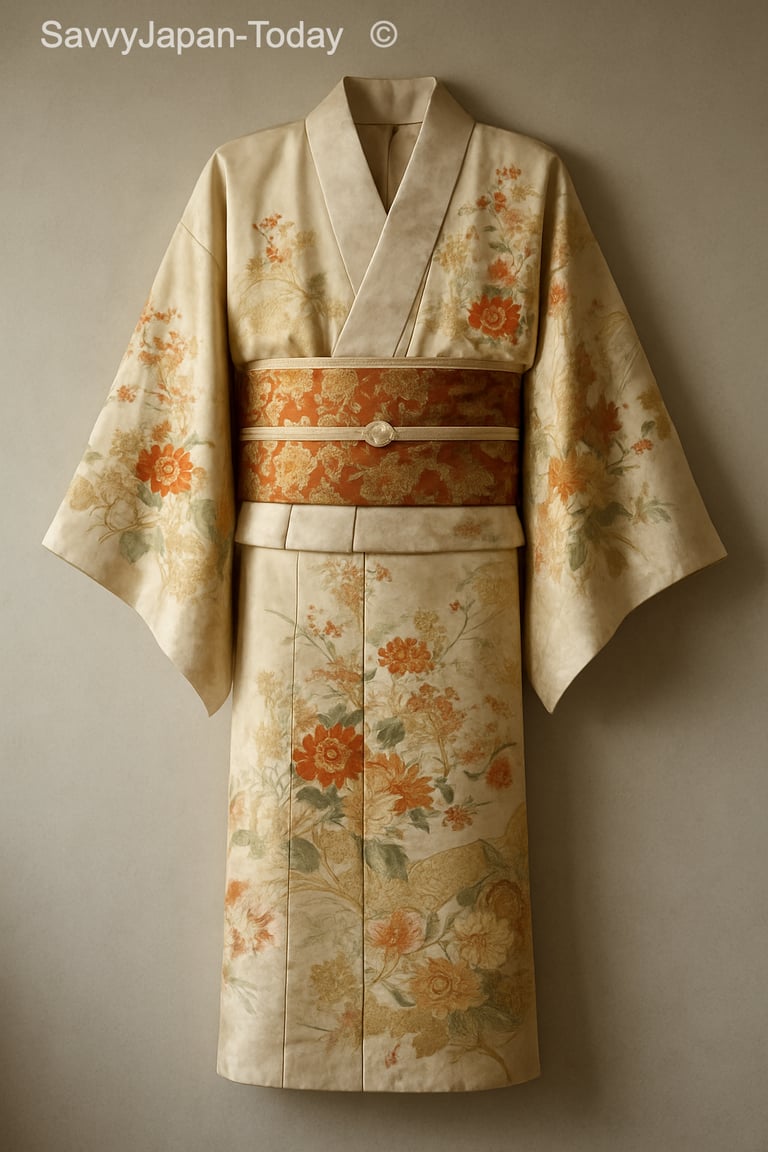
So here’s the thing: this women's Japanese kimono — the one hanging so gracefully, the one with the soft cream silk and those delicate orange-gold floral patterns — it’s priced at $540,000.
And yes, before you even ask, it ships free. I mean, for that price, it better come with free shipping, a thank-you card, and maybe someone bowing politely as they hand-deliver it.
But honestly? Once you understand how kimonos are made, and the history behind them — especially pieces at this level — that price starts to make a strange kind of sense.
It’s not that it’s “just a piece of clothing.” A kimono like this is almost like wearable history… wearable art… maybe even wearable soul, if that doesn't sound too dramatic.
Let me walk you through it.
First, the silk — and the “mid-grade” part.
So, the kimono you’re looking at is made from mid-grade silk. Now, I know “mid-grade” sounds like something between bargain-bin polyester and high-end luxury, but in kimono terms? Mid-grade silk is still ridiculously soft, luminous, and extremely finicky to work with.
Silk in Japan isn’t just fabric. It has history. Tradition. Spiritual meaning. Farmers raise silkworms, feed them carefully, spin the threads — and then the weaving itself is another whole art form.
Even “mid-grade” silk can take months to prepare, especially when the final piece is intended as a formal kimono.
This type of silk hangs in a way that feels soft and alive. When you touch it, there’s this cool, almost watery smoothness, like the fabric is quietly breathing with you.
The kimono in the picture captures light in that subtle, shimmery way that only silk can. No other fabric even comes close.
Then there’s the design — the handwork, the patterns, the dyeing.
If you look closely at the kimono (especially at the flowers), there’s this softness to the gradient, these incredibly fine lines inside every petal, and gold accents that don’t shout but whisper.
That’s not machine work. Machines try, but they never quite get that “human hand” warmth.
Japanese floral motifs always mean something, too. The ones pictured here — chrysanthemums, peonies, maybe some maple leaves — these aren’t random.
They represent seasons, life, elegance, resilience. A kimono is basically a coded message if you know how to read it.
And the painting or dyeing process? Whew. I've watched a craftsman once — just once, because watching someone do something with that much concentration makes you feel like you should breathe more quietly.
They hold the brush like it’s a living thing, stroke by stroke, layering color into the silk so gently it barely seems real. The way the pigments sink into the fibers? It’s mesmerizing.
So the price isn’t just fabric. It’s the artist. The hours. The decades of training. The fact that only a tiny group of people left in Japan can still do this at all.
A quick detour — the history of the kimono.
Okay, I swear this’ll be quick. But it matters because the kimono you’re looking at isn’t just a garment — it’s part of a long, long story.
Way back in the Heian period (think over 1,000 years ago), the kimono took shape as layers upon layers of robes.
They weren’t even called “kimonos” yet — more like kosode, literally “small sleeves.” Over time the look evolved, and by the Edo period, people were wearing kimonos the way we picture them now.
But here’s what gets me every time: kimonos used to act like a person’s resume. Their patterns, colors, sleeve length, and even how they were tied told the world who they were — unmarried, married, wealthy, artistic, samurai family, merchant family, you name it.
And unlike modern fast-fashion? These weren’t clothes you wore for a season and tossed. Kimonos were made to outlive the person who bought them.
They were passed down through generations. Re-tailored. Reinvented. Turned into household items when they became too worn to wear.
There’s something beautifully cyclical about that — the idea that nothing goes to waste, that fabric carries memories.
Back to this particular kimono… because wow.
The one in the photo looks serene and elegant, almost like it’s whispering old poetry. Seriously, it has that vibe.
The cream silk sets such a calm tone, but the gold and orange florals bring life to it — like a peaceful garden in early autumn.
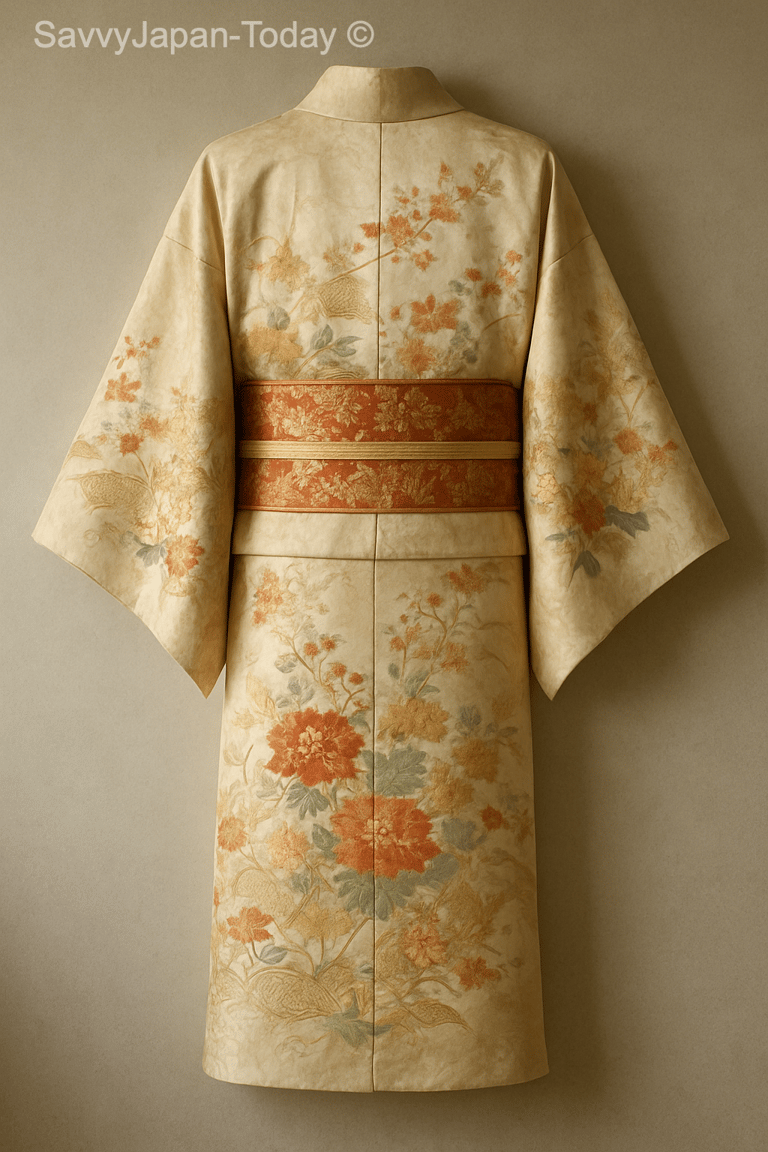
And the back view? Don’t even get me started. The way the pattern flows from the shoulder down to the hem, uninterrupted and perfectly aligned — that’s craftsmanship you can’t fake.
If the front is the face, the back is the story. Japanese kimono artists know that people will see you from behind just as much as from the front, so the rear design gets equal love.
And let me tell you, getting patterns to match perfectly along the seams is almost impossibly hard. That alone could justify a few thousand bucks, honestly.
Now… let’s talk about the price again. $540,000.
Yeah, it’s a lot. Like, buy-a-house level. But hear me out.
A kimono like this isn’t something you wear to dinner, spill soy sauce on, and then toss in the wash.
This is an heirloom-level piece. Something a family might keep for generations. Something that ends up in museums. Something that could be exhibited as art.
$540,000 covers:
The silk
The weaving
The dyeing
The hand-painting
The embroidery (if any)
The finishing
The artisan’s decades of experience
The preservation techniques
The absolute rarity
Plus the reality that only a few people in the world can even make something like this anymore.
Supply is shrinking because fewer young craftspeople are entering the field. Imagine taking on an apprenticeship and earning almost nothing for years just to learn how to properly paint silk. Very few people commit to that.
So yeah, the price seems wild — but it’s tied to the survival of an entire craft tradition.
And hey… free shipping.
I know, I know. It’s funny to even say it. But there’s something almost charming about it. Like, “Yes, this kimono is half a million dollars, but don’t worry — we’ll cover the postage.”
If I’m being honest…
Looking at this kimono, I feel something a little bittersweet. Because pieces like this remind me of the parts of Japanese culture that are delicate and quiet, the parts that are slowly fading because they take too long, cost too much, or require a kind of dedication most modern people don’t have time for.
But at the same time? Seeing this kimono gives me hope. It means someone is still keeping that fire alive.
And I kind of love that.
If you ever had the chance to see one of these in person — even if you never buy it, even if owning it is impossible — take it. Stand there.
Look closely. Let your eyes follow every brushstroke. It feels like standing in front of a 500-year-old painting that somehow ended up on fabric.
If you or someone you know would like information on purchasing this or another Kimono from SavvyJapan-Today, please feel free to either contact us by calling our office in Japan or send us a message utilizing the form below. Thank you.
Questions? Contact SavvyJapan-Today at: +81.70.9041.6946 Tokyo, Japan
HAVE YOU SEEN THIS? What is Christmas Fashion in Japan for Women?
Savvy Japan: Today © 2026
Always Do Good
Tel: 070.9041.6946